
Collection of a unique dataset across Europe
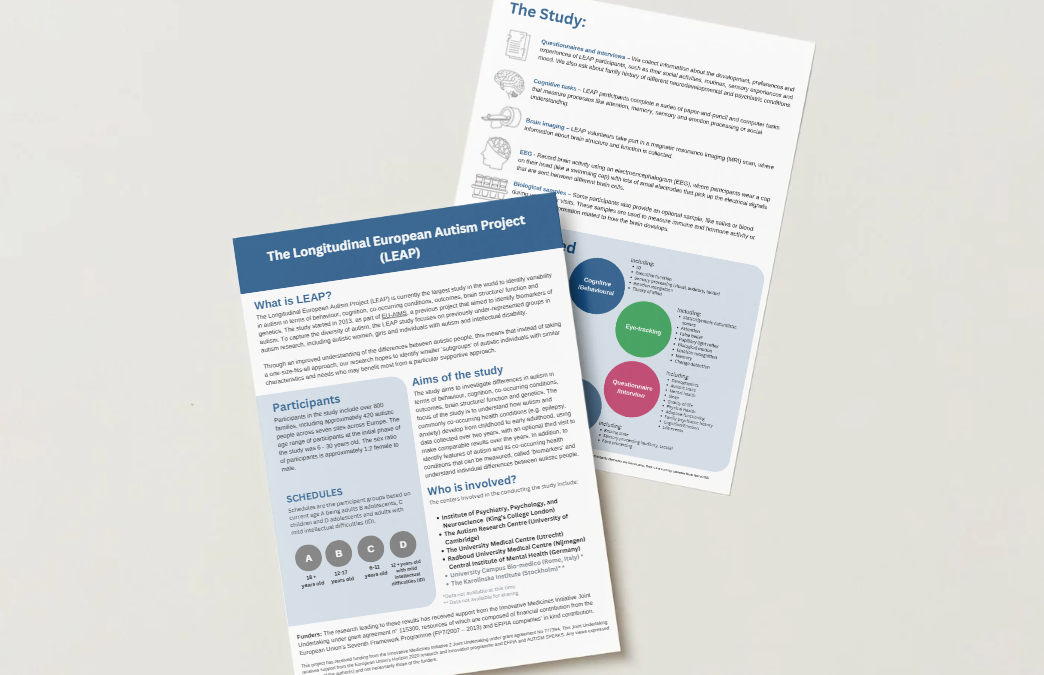
The Longitudinal European Autism Project (LEAP) is a pioneering European project that aimed to identify biological characteristics (biomarkers) that are common or distinct between autistic people and that could help predict an autistic person’s likely developmental trajectory or support needs. We collected comprehensive information from 430 autistic people and 300 non-autistic people or those with mild intellectual disability at six research sites across Europe. This included comprehensive information on clinical features (autistic features), co-occurring neurodevelopmental and mental health conditions (such as ADHD, anxiety and depression), behavioural and cognitive profiles (using computerised tasks and eye-tracking) brain development and function (MRI brain scans, EEG), immune markers, genomics and environmental information. Between 2014-2026 we followed children, adolescents and adults originally recruited between the age of 6-30 years) on three occasions.
Several aspects of the design were unique:
- The study included autistic people with co-occurring conditions such as ADHD or intellectual disability who were previously often excluded from autism studies)
- The study aimed to more accurately represent autistic females by recruiting autistic females to form one third of the autistic sample. See our LEAP leaflet for an overview of the project.
- The study used the same core protocol in all participants (including appropriate adaptations for age and ability level).
Key scientific papers and findings
The large-scale data set of LEAP has allowed researchers to investigate previous reports of group differences between autistic and non-autistic people. In a first step, we investigated group differences across all levels, including cognition, brain structure, function and tested some of the most influential theories of autism. This resulted in the replication of some findings, but also so-called null findings, which are equally important for furthering scientific understanding of autism. For example, we found average group differences in theory of mind, executive function and emotion processing (when tested behaviourally, but not in terms of underlying brain function). We replicated differences in brain structure with small effect sizes but did not find differences in EEG power bands (measure of specific brainwave frequency).
Overall, there was considerable overlap between autistic and non-autistic people in various cognitive and brain-related characteristics. We estimated that when statistical effects are moderate or even large, this translates to 48-70% of autistic people falling within the ‘typical range’, showing no difference or atypicality statistically.
These initial sets of findings prompted us to develop new methods and approaches to identify potential sub-groups among autistic people with specific cognitive or neurobiological characteristics.
Over 100 research papers, including the LEAP data collected as part of EU-AIMS and AIMS-2-TRIALS projects, have been published. Some examples of initial findings using data from the first and second assessment waves are included below, and other publications can be found on the AIMS-2-TRIALS publication page here.
- Multiple types of data were collected in LEAP to look at the relationship between different measures, and how these differ in autistic and non-autistic people. Researchers found that when they combined information from multiple types of data in a multi-modal model, such as brain function during rest and while completing various tasks as well as measures of brain anatomy, they found substantially higher average differences between the autistic and non-autistic groups than when only single measures were compared. Within the autism group, individual differences in the multifunctional model were associated with cognitive and social but not non-social and functioning characteristics of autism. This shows that combinations of measures are more informative that any single measure at understanding differences in autistic people. More information can be found via this paper
- The timing of the N170, a pattern of brain activity measured using EEG (electroencephalography) and related to face processing, was identified as a potential ‘biomarker’ that may help to identify who will respond most to certain kinds of support strategy and prevent those unlikely to benefiting from starting with it in the first place. This measure provided a helpful way to identify subgroups of autistic people who shared similar social outcomes two years later. See this news piece for further information
- Cortical thickness of the brains of autistic and non-autistic people was examined using structural MRI scans. The brain cortex is one of many indicators of brain anatomy, measuring cortical thickness is one method used to map a person’s brain structure and understand how this may be related to behaviour. Individual differences among autistic people based on this measure were identified and were found to be related to genetic likelihood for autism and sensory subgroups.
More information can be found via this paper
- Differences in functional connectivity patterns in the brain between the cerebellum and other brain areas were identified, including increased connectivity of the cerebellum with sensory and motor networks. This finding could explain multisensory and visual motor differences in autism. More information can be found via this paper
- Researchers investigated the influence of environmental and family conditions on mental health, with a particular focus on understanding internalising symptoms (such as anxiety and depression) and externalising symptoms (such as aggression and impulsive behaviours). This research included autistic people across a wide age range and across countries, using the LEAP and a South African cohort. Participants with more autistic traits were found to experience more mental health challenges across countries. Furthermore, the “Family System” (family size, composition, maternal factors) consistently influenced mental health, but its specific impact varied. Across the LEAP cohort, the Family System had a protective effect against mental health symptoms; in South Africa, this relationship was reversed, with participants with larger families being more susceptible to experiencing mental health conditions, suggesting this may be impacted by the high/low-middle income setting. In both cases, autistic traits diminished these effects. These results reinforce the notion that context and autistic traits interact to influence mental health, and that the household support should be considered when providing support to autistic individuals, especially when considering regional differences in diagnosis and service availability. More information can be found via this paper
- Researchers investigated the wellbeing of autistic children and adults in the LEAP cohort. Although well-being was on average lower for in the autism than the non-autistic group, a notable proportion (36%–71% across quality-of-life domains) of autistic individuals reported good well-being. Reduced wellbeing was related to depression symptoms, across all ages. For children and adolescents, anxiety and social-communication difficulties were also related to quality of life. The study suggests that support and services to improve mental health, especially depression, may also improve broader wellbeing and quality of life for autistic people. More information can be found via this paper: More information can be found via this paper
- Researchers identified a subgroup of autistic people who had difficulties with emotion recognition compared to the rest of the group. This was based on the combination of performance across three different tests. This subgroup had higher scores on measures of autistic characteristics, lower scores on measures of adaptive behaviour and showed brain functional differences. These findings suggest support in emotion recognition could be helpful for supporting social interaction in a subset of autistic individuals, if they wish to seek support. More information can be found via this paper.
For the latest updates on papers, including ones currently under review, see our publications page.
Community collaborations and priorities
LEAP brought together different experts (e.g., clinicians, neuroscientists, biologists) to provide the necessary expertise to carry out this study and interpret the outcomes. AIMS-2-TRIALS’ collaboration with autism community members on projects using LEAP data has been an important part of the project and ensures community perspectives are incorporated in the research process (see A-Reps page for more details). This has also helped develop a template of how collaborative working with the community can be done in future work. An example of this work within LEAP is a research paper sharing the genetic findings from the study, which includes several community members as co-authors who were part of the data interpretation and write up of the paper. A pre-print of this paper can be found here.
Driven by community engagement and policy work in AIMS-2-TRALS, there has been a shift in focus of LEAP projects and papers toward sensory, mental health, developmental perspectives and further investigation of co-occurring epilepsy to reflect community priorities in these areas. This aligns with the priorities highlighted by the AIMS-2-TRIALS A-Rep group and published work by our group and others (Cage et al. 2024, Ikhsan, Holt et al 2026).
Data analysis projects from LEAP have had an increased focus on mental health and the impact this has on quality of life of autistic people. To ensure community perspectives are incorporated in this work collaborations were set up on several mental health projects using LEAP data including researchers and autism community members. There has also been an increased focus on co-occurring ADHD in autistic people and the challenges associated with this condition, as a result of community prioritisation of this area of research. Lastly, new work building on the LEAP study, examining autistic burnout is being carried out in collaboration with autism community members.
This project has had greater focus on the variation within autism in our approaches and analysis techniques. This had included identifying subgroups of autistic people who differ in terms of biological characteristics such as genetics or brain structure or function and also differ in terms of behavioural characteristics. These groups likely differ in terms of the support they need and the how effective certain interventions might be. This provides steps towards a more personalised approach to autism both in terms of support and treatment approaches for those that want and need them. We are now in a position to trace developmental trajectories by combining the data from each volunteer across 3 time-points and over 8-12 years. This provides the critical basis to identify markers for the progression of specific clinical features, their combination, or changes in quality of life.
Wider impacts from the project
LEAP researchers have developed and made methodological advances in research techniques such as normative modelling, which provide new ways of looking at variation within groups and development over time. This could allow researchers to make predictions about individuals which is a vital step towards being able to provide personalised interventions and support. This technique creates a reference model of development (for example of brain structure) and qualifies how much each individual differs from that model, or the statistical ‘norm’*. This method aims to better quantify statistically the variation within autism across development and therefore improve understanding of the diversity of autism. These techniques were not available at the beginning of the project and have required development to address the statistical questions required in this context. The statistical models and methodologies used are therefore an important resource for future work in this area.
Analysis techniques used in AIMS-2-TRIALS have given more consideration to the heterogeneity of autism, going beyond the historical focus on ‘case control’ differences (i.e., differences between autistic and non-autistic people, on average). This is important to help understand differences within groups of autistic people, and how these relate to diverse outcomes. This could, in the future, support the development of more personalised support for autistic people (including medical and non-medical approaches depending on a person’s preference and needs). These approaches include looking at subgroups or clusters within and across groups as well as normative modelling techniques which look at developmental trajectories. Modelling developmental trajectories can allow us to see and predict how people develop over time on different measures such as brain structure, performance on a particular task or clinical characteristics such as depression and anxiety or sensory sensitivity. This leads to better ways of mapping variation within autism as it shows the variation and helps identify any patterns within this that could in the future be useful for diagnosis, individualised support and interventions for those that want and need them.
Historically, autistic people with a co-occurring intellectual disability have been an under-researched group. LEAP includes unique data from a subgroup of autistic people with co-occurring mild to moderate intellectual disability which have been analysed and can be further utilised in the future to increase understanding about this group of autistic people. The data from LEAP can also be combined with other AIMS-2-TRIALS cohorts such as SynaG to increase statistical power and validate findings. SynaG included people with rare genetic conditions associated with autism and intellectual disability including Phelan McDermid syndrome and NRXN.
More about this project can be found here via this website page
Researchers showed that a particular feature of EEG (electroencephalography) data in called N170, a brain response that reflects face processing, was different in autistic people and could be a potential biomarker of autism. These finding suggests a difference in the brain’s processing of faces in autistic people. More details can be found here. Following analysis and validation of the N170 biomarker using LEAP and data from other cohorts, AIMS-2-TRIALS embarked on a unique process to validate this marker with European Medicines Agency (EMA). This was the first work with a potential biomarker in the autism field to do this. See the news piece on this work for more details. Identification and further validation of biomarkers should allow for more effective research into autism, including interventions and support for core and co-occurring characteristics for those that seek them.
LEAP data has significant potential to inform new and innovative methods and scientific progress in the future, including for the research community beyond AIMS-2-TRIALS. This is made possible via sustainable data sharing on the ELIXIR platform. The AIMS-2-TRIALS data sharing process has been designed in collaboration with autism community members to ensure that data would be shared in an ethical manner and following recommendations from the community. Data is only shared for participants that explicitly gave their consent to share data beyond the research consortium. Applications to access data are reviewed by the data access committee, including scientists and community members to ensure future projects are of a high quality and meet AIMS-2-TRIALS consortium principles. This offers autism researchers beyond the project an opportunity to analyse data to address new research questions. This also opens up an opportunity for researchers combine different data types from the LEAP project, and with data from other projects (e.g. ABC-CT, InovAND, SFARI, POND) for the purposes of replication of findings. This provides greater validity of research findings.
See the data sharing FAQs and the ELIXIR platform for more information.
Want to find out more?
See AIMS-2-TRIALS YouTube videos for more details on some of these topics, including the LEAP ‘Meet our researchers’, where our work on sensory, mental health, epilepsy and brain activity are discussed. The autistic burnout video explores our work with community members on this topic, and the LEAP Epilepsy video explores co-occurring autism and epilepsy, and the important inclusion of this work within LEAP.
For further information on the LEAP project, see the LEAP page here and the LEAP flyer here.
*this term is used in the context of statistical terminology not in reference to individual variation.