
Data Access: Participants

Information & Frequently Asked Questions (FAQs)
About AIMS-2-TRIALS LEAP:
This section addresses what AIMS-2-TRIALS and the Longitudinal European Autism Project are.
What is AIMS-2-TRIALS?
As a LEAP participant, when you first joined the study, it was funded by EU-AIMS, which stood for European Autism Interventions – a Multicentre Study for Developing New Medications. This project ran from 2012 until 2018. It was funded by the Innovative Medicines Initiative.
In 2018, LEAP was extended for a third time point as part of the project AIMS-2-TRIALS, which stands for Autism Innovative Medicines Studies – 2 – Trials. The AIMS-2-TRIALS project runs from June 2018 until November 2026. AIMS-2-TRIALS is funded by the Innovative Health Initiative.
In-kind contributions (such as time and resources) have also been given by pharmaceutical companies (Hoffmann La Roche, Janssen) and charities (Simons Foundation for Autism Research, Autism Speaks, Autistica) to support this research programme.
The overall goal of this project is to improve health outcomes and well-being for autistic people.
What is the Longitudinal European Autism Project (LEAP)?
Since the beginning of this study, over 700 families (including you!) in England, Germany, the Netherlands, Sweden, and Italy have participated in the Longitudinal European Autism Project (LEAP).
This study is currently the largest study in the world to identify variability in autism in terms of behaviour, cognition, co-occurring conditions, outcomes, brain structure/function, and genetics.
We are immensely grateful to you and all of our volunteer families for your time and commitment.
Through an improved understanding of the variability between autistic people, our goal is to identify ‘subgroups’ of individuals with similar characteristics and needs who may benefit most from particular support strategies (e.g., for sensory sensitivities, epilepsy, anxiety), rather than taking a ‘one size fits all’ approach.
What is the AIMS-2-TRIALS external database?
The goal of the AIMS-2-TRIALS external database is to share AIMS-2-TRIALS data with the wider global research community.
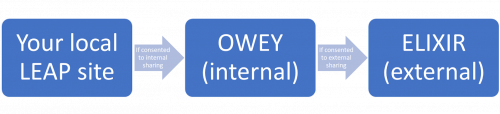
‘External’ refers to researchers outside of the AIMS-2-TRIALS consortium. The AIMS-2-TRIALS external database is hosted via ELIXIR, located in Luxembourg.
This is different from ‘internal’ data sharing, which means data sharing only between researchers within the AIMS-2-TRIALS consortium. The AIMS-2-TRIALS internal database is hosted via OWEY, located in Paris, France.
Why is LEAP data shared externally, beyond the AIMS-2-TRIALS Consortium?
Data sharing is a crucial element of research. Sharing of scientific data among researchers helps to speed the rate of scientific progress enormously. More data from more people allows researchers to be more confident that the results of their analyses are accurate (can be replicated more than once by different researchers) and representative.
Sharing AIMS-2-TRIALS data will make it easier for researchers to find and explore data from multiple datasets, so that analyses can include, for example, several thousand people, rather than several hundred. Data sharing has many other benefits such as encouraging transparency and accountability, and facilitating collaboration between research groups around the world.
Where is the AIMS-2-TRIALS external database hosted?
The AIMS-2-TRIALS external database is hosted on a platform called ELIXIR. The goal of ELIXIR is to make life science data easier to find, share, put together, and analyse.
Each country that is a member of ELIXIR has a “node”, which is the collection of research institutes that work for ELIXIR in that country. The AIMS-2-TRIALS external database will be hosted on the ELIXIR Luxembourg node.
ELIXIR (and its Luxembourg node, specifically) was selected as the best fit for hosting the AIMS-2-TRIALS external database, as it is an existing GDPR compliant European infrastructure for long-term sustainability of life sciences data.
Where will AIMS-2-TRIALS data be stored?
Data will be stored by ELIXIR, an organisation based in Luxembourg. Researchers outside of the AIMS-2-TRIALS project can apply for access to the data via ELIXIR. ELIXIR will manage the application process with input from the study sites and the external database review committee.
A copy of the data will be stored by Institute Pasteur based in Paris who have hosted the data throughout the project. For more details on the ‘internal database’ see our website.
What is ELIXIR?
ELIXIR is a data hub for medical science research. They host a secure database for sharing research data. ELIXIR (and its Luxembourg node, specifically) was selected as the best fit for hosting the AIMS-2-TRIALS external database, as it is an existing GDPR compliant European infrastructure for long-term sustainability of life sciences data.
How do you ensure that data is used in line with autistic preferences and ethical considerations?
Researchers wanting to access the data will need to apply for access. This process includes writing a proposal and providing evidence of ethical approval/ code of conduct as well as agreeing to our data access policy.
All project proposals will be reviewed by the project review committee which includes autism community members and researchers from the AIMS-2-TRIALS consortium. The review committee will check the proposals for a number of key requirements this includes checking proposals are in line with original consent wording, and checking they meet our Consortium Principles (Beneficence, Inclusion/Engagement, Culture/Language, Minimising Risk). See ‘When access to LEAP data is requested for research, how is this reviewed and approved’ for more details.
Autistic people and parents of autistic people also advised on the design of the data sharing and review process.
What data is being shared?
Data collected as part of the Longitudinal European Autism Project (LEAP), which included MRI brain scans, eye tracking measures, questionnaires, computer tasks and interviews.
You can read more about LEAP in our LEAP leaflet. Currently only data from the first and second time point of the study will be shared in this way (from 2013-2015) but there are also plans to share data collected later.
Who funds the AIMS-2-TRIALS external database?
AIMS-2-TRIALS is funded by the Innovative Medicines Initiative (grant agreement No. 777394) until November 2026. In-kind contributions (such as time and resources) have also been given by pharmaceutical companies (Hoffmann La Roche, Janssen) and charities (Simons Foundation for Autism Research, Autism Speaks, Autistica) to support this research programme.
The external database of AIMS-2-TRIALS data will be supported by ELIXIR for a minimum period of 15 years. The consortium are currently seeking funding to support ongoing data sustainability beyond the current AIMS-2-TRIALS grant such as supporting internal hosting, data processing and funding the review committee.
When access to LEAP data is requested for research, how is this reviewed and approved?
To apply for LEAP data access, the project team needs to have a registered account in ELIXIR Luxembourg. They must sign that they have read and understood the AIMS-2-TRIALS data access information, procedure and policy.
Investigators need to be affiliated to a University, research institute, or registered company (and/or a professional body with a robust code of ethical conduct) to ensure compliance with European data security, ethical, and legal standards.
We strongly encourage researchers applying for access to AIMS-2-TRIALS data to work with lived experience experts, who should be indicated as affiliated to the Lead Investigator’s Institution (if they are not currently affiliated to a University, research institute, or registered company).
The project team must provide a project proposal that describes how they will use the data for research. This proposal must be ethically approved (or comply with relevant codes of conduct) and align with the AIMS-2-TRIALS Consortium Principles.
Project proposals are reviewed by the AIMS-2-TRIALS LEAP Project Review Committee (LEAP PRC). The LEAP PRC includes representatives of the autistic community (including autistic people, parents, and carers), AIMS-2-TRIALS project leads, and analysis experts relevant to the project proposal submitted.
We review proposals against the following checklist:
- Must comply with participant informed consent wording
- Must comply with each of our Consortium Principles (Beneficence, Inclusion/Engagement, Culture/Language, Minimising Risk) and language guidelines
- Must have submitted proof of ethics approvals/code of conduct
- Must have submitted a data management plan (how data will be stored/used)
- Must have clear and specific aims
- Must detail analysis plan clearly
- Must be within the scope of one scientific paper
- Must make a unique contribution to science
About ethics and consent
This section describes what consent was given for data to be shared externally, and how you can withdraw your consent if you wish to. It includes information on how the autism community have been consulted regarding our data sharing processes, and the ethical safeguards in place to keep data safe.
Did AIMS-2-TRIALS consult with the autism community on LEAP data sharing plans and processes?
Yes, we worked with a group of autistic people and parents of autistic people to gather perspectives and input on plans for sharing AIMS data beyond the consortium.
The group commented on key ethical considerations around data sharing, reviewed and developed our data sharing procedures, and raised concerns that they wanted us to ensure were addressed. These included the security of data, participant consent and the right to withdraw consent, and how applications to access the data are reviewed.
The AIMS-2-TRIALS Project Review Committee (LEAP PRC) includes representatives of the autistic community (including autistic people, parents, and carers), alongside researchers from the consortium.
We also consulted a larger number of autism community members about the perspectives on data sharing using a survey – we will publish the results here once available.
For more information on the consultation process, please see our news piece here.
What ethical safeguards are in place for my data?
Data are only available to researchers beyond the AIMS-2-TRIALS Consortium from participants who explicitly consented to this.
The AIMS-2-TRIALS LEAP Project Review Committee (who review project proposals) also check that the project proposal is in line with the research themes that participants consented for their data to be used for in the original consent forms.
Researchers applying for access to AIMS-2-TRIALS data must submit proof of ethics approvals (and/or relevant codes of conduct) and data management plan for their project proposal and consider the ethical implications of their project (in consideration of the AIMS-2-TRIALS Consortium Principles).
What consent did I and/or other LEAP participants give for our data to be shared?
When you took part in the LEAP study, we asked you (or your parent where appropriate, for instance, if you were a minor at the time) about your consent preferences for different parts of the study. If you were a minor and your parent consented on your behalf, but you have now turned 18 and wish to check/alter your consent preferences, please see the corresponding FAQs. Please note, if you are a LEAP participant from the Karolinska site, Sweden, you were not asked to provide consent for external data sharing and your data will not be included in the AIMS-2-TRIALS external database.
One of these consent preferences was for data sharing with researchers within the AIMS Consortium (‘internal’ data sharing). This is done using our AIMS-2-TRIALS internal database OWEY, located in Paris, France.
The other of these consent preferences was for data sharing with researchers beyond the AIMS Consortium (‘external’ data sharing). This is done using the AIMS-2-TRIALS external database on the ELIXIR Luxembourg node. Your data will only be shared via ELIXIR if you said ‘Yes’ to data sharing beyond the Consortium. If you said ‘No’ to data sharing beyond the Consortium, your data will not be shared via ELIXIR (even if you said ‘Yes’ to data sharing within the Consortium).
I can’t remember if I consented for my data to be shared. How do I find out?
If you wish to check your consent preferences, please contact your local research team (where you took part in the study):
London – eu-aims@kcl.ac.uk /info-compliance@kcl.ac.uk
Cambridge – cambridgeleap@medschl.cam.ac.uk in the first instance or dpo@admin.cam.ac.uk
Nijmegen – aims.leap3@gmail.com /gegevensbescherming@radboudumc.nl
Mannheim ZI_AIMS2trials_Team@zi-mannheim.de/ datenschutzbeauftragter@zi-mannheim.de
If you participated in Rome, or Utrecht your data will not, at present, be shared with the external database (if you have any questions, please contact your local research team where you took part in the study). We will update this page with any updates on data sharing from the different study sites.
If you participated in Karolinska, you were not asked to consent to this and your data will not be shared in this way at any time.
I consented for my data to be shared, but I have changed my mind. What can I do?
If you wish to change your consent preferences, please contact your local research team (where you took part in the study):
London – eu-aims@kcl.ac.uk/info-compliance@kcl.ac.uk
Cambridge – cambridgeleap@medschl.cam.ac.uk in the first instance or dpo@admin.cam.ac.uk
Nijmegen – aims.leap3@gmail.com /gegevensbescherming@radboudumc.nl
Mannheim – ZI_AIMS2trials_Team@zi-mannheim.de/datenschutzbeauftragter@zi-mannheim.de
Please note that it will not be possible to withdraw your data from projects that have already taken place. For example, if a researcher has already completed a project that included your data, they will not be able to remove your data from that project.
I’m ok with my data being shared. But can I change my mind later?
Of course! If you no longer wish for your data to be shared, you can withdraw your data from the external database at any time. You do not have to give us a reason.
This will not affect your medical care or legal rights in any way. It will also not affect your right for travel reimbursement and participant payment up until that point.
Please be aware that, at this time, withdrawal of your data will be for all future projects (rather than on a project by project basis). However, you can also opt back into external data sharing at any time.
Please note that it will not be possible to withdraw your data from projects that have already taken place. For example, if a researcher has already completed a project that included your data, they will not be able to remove your data from that project.
About how my data is stored and used
This section describes how data is securely stored, and how you can find out who is using your data, and for which research projects.
How is my data stored, and is it secure?
Your data will only be shared according to the consent forms signed by you (or your parent where appropriate, for instance, if you were a minor at the time). Your data will remain subject to the local regulations and privacy policies of the local research team where your data was collected.
As soon as you were enrolled in the study, you were assigned a secure identifying code, meaning your data became ‘coded’. All study assessments use these codes, never your name. For additional data security, when your data was sent to the AIMS-2-TRIALS internal common database (‘OWEY’; located in Paris, France), a second secure identifying code was assigned. Personal data like addresses, names, and emails will NOT be shared.
Researchers who wish to access AIMS-2-TRIALS data have to confirm that they have read, understood, and acknowledged our data access policy/procedure. If researchers who wish to access AIMS-2-TRIALS data fail to abide by the guidelines provided, their privileges to access data (including any future requests) will be terminated. ELIXIR uses two factor authentication meaning users need to provide two forms of identification when logging in to provide an additional layer of security.
For further information
This section provides links to further information about ethics and data sharing in autism research.
How can I find out more about ethics and data sharing in autism research?
Data sharing in child and adolescent psychiatry research: Key challenges (and some potential solutions) https://open-research-europe.ec.europa.eu/articles/5-93/v1
Autism data sharing: Benefits, challenges, and recommendations. PLOS digital health.